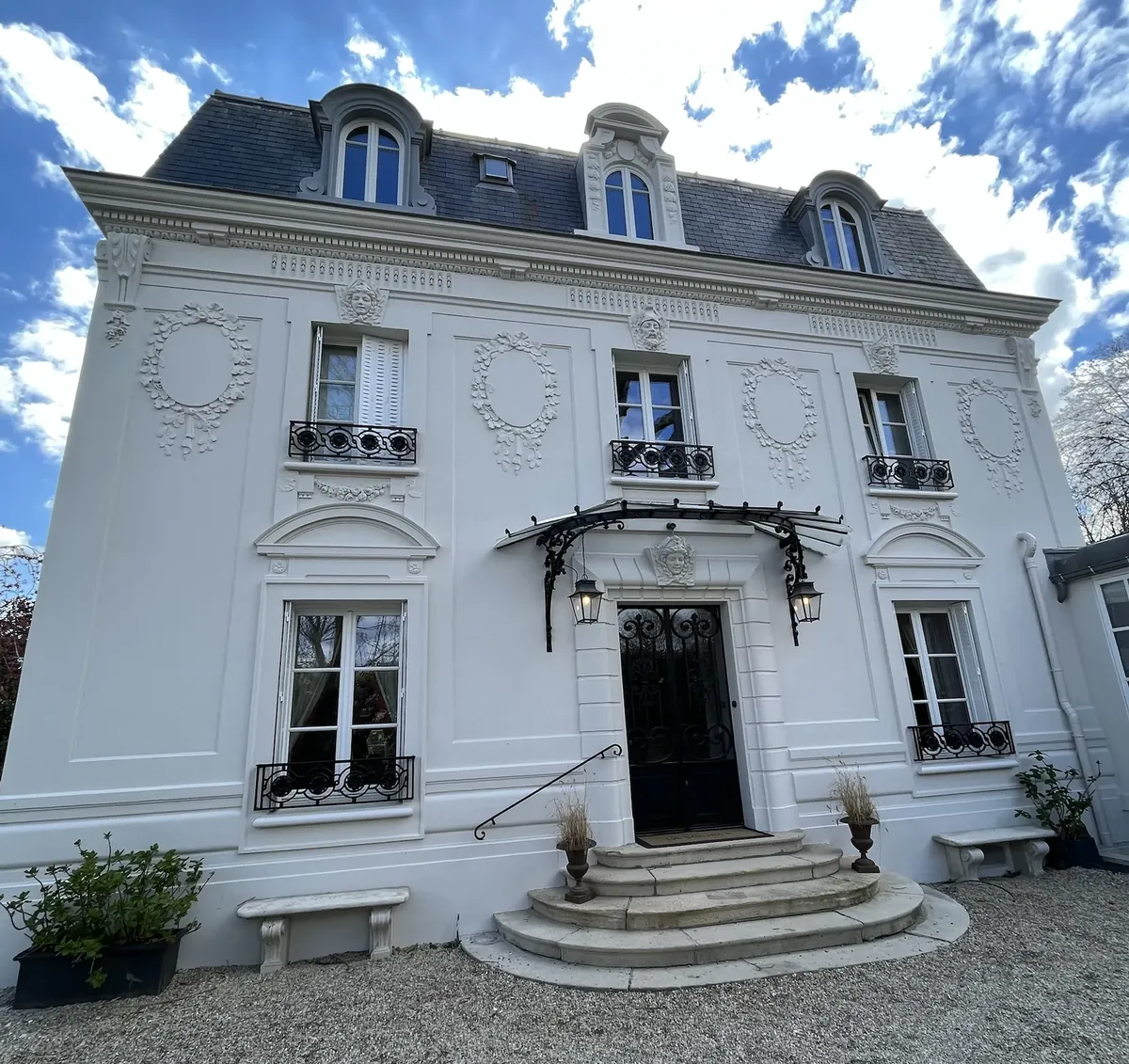
Restoring the facade of a period house means cleaning and repairing it with materials that suit the wall: lime rather than cement, gentle cleaning rather than a high-pressure jet, mineral paint rather than a plastic film. I read the facade first, then describe the work it needs in a detailed quote with FRONTIS, the facade company I work with.
Millstone villas: what makes them different?
Millstone, or meulière, is a very hard, silica-rich stone full of small cavities, used as an exposed facing from the late nineteenth century. According to France’s national building database (BDNB), it is the most common wall material among houses built before 1948 in Saint-Maur-des-Fossés, Le Perreux-sur-Marne and Nogent-sur-Marne.
The Saint-Maur facade charter, written with the CAUE 94 (the Val-de-Marne council for architecture, planning and the environment), sets out how to treat it:
- exposed millstone stays exposed, as long as its condition allows;
- the stones were laid in lime and sand mortar, but the joints were often finished in cement or a cement-lime mix;
- those hard joints crack around fixings and ironwork, and the decorative chips fall out;
- damaged joints are raked out and remade to match the original, with or without their decoration.
That decoration is called rocaille: small chips of millstone, pebbles, ceramic, flint, shells or clinker pressed into the joints, often in a lime mortar tinted brick-red with crushed terracotta. The page on millstone facades (in French) goes further.
Why lime, not cement?
An old wall takes up moisture from the ground and releases it as water vapour through its facade. That exchange only works if the render lets vapour through as readily as the wall. Cement is strong but lacks that permeability, and it is too rigid for old masonry: the Saint-Maur charter rules out cement and cement-lime renders on old walls, and plastic coatings too.
When a wall cannot dry outwards, the moisture moves inside: blistering paint, mould, rotting timber lintels, rusting metal, flaking stone. Lime hardens slowly by taking up carbon dioxide from the air, a process called carbonation, and as it sets it forms fine capillaries that let the wall breathe. It is also softer, and a render should never be harder than the wall it covers.
I recommend a lime render system in layers: a key coat, a body coat, a through-coloured finish coat and, where it suits, a limewash. A through-coloured render is not painted. Where a fine lime render is used to restore mouldings and is then painted, it needs at least five days of carbonation first, and the scaffolding stays up meanwhile.
Near a historic monument, expect lime systems to be required and cement-resin mortars to be ruled out. The comparison is set out in lime or cement render (in French).
How should a facade be cleaned?
Gently. The Saint-Maur charter recommends running water or hydrogommage, a low-pressure mix of water, air and fine powder. It advises against high-pressure washing, which drives dirt into the cavities of the stone, and favours a moderate, adjustable pressure with a rotating jet. Detergents should be as close to neutral pH as possible; moss and lichen are treated with fungicides and algaecides.
Brick and stone
Exposed brick stays exposed. The charter asks for cleaning at a pressure suited to the brick, and repointing like for like: lime on lime, plaster on plaster. Glazed bricks and ceramic details, used in the early twentieth century, are part of the facade and are kept.
Where limestone has become friable, it is consolidated first, and the charter is clear that this comes before any water repellent, never the reverse. Cracks are read before they are filled: every crack lets water in, and a structural crack must be stabilised before the facade is redone. When more than half of a render needs repair, the charter considers it better to strip it and start again.
Mineral silicate paint (KEIM)
When a facade is to be painted, I recommend a mineral silicate paint. Its binder reacts with the mineral surface, render or stone, and bonds with it rather than forming a film on top: the wall keeps breathing, and the mineral pigments hold their colour. FRONTIS is a KEIM-approved applicator. The colour is chosen from a colour chart and its reference is written into the quote.
What does facade restoration cost?
These figures are indicative. The price of your facade is set after the visit, in a detailed quote.
| Work | Indicative price | Reference |
|---|---|---|
| Standard facade renovation: cleaning, surface repairs, new finish | €80 to €120 per m², including VAT | Market range published by FRONTIS |
| Facade renovation with external insulation | €130 to €180 per m², including VAT | Market range published by FRONTIS |
| KEIM mineral paint on an existing surface: Contact-Plus primer and two coats of Soldalit | €85 to €90 per m², excluding VAT | FRONTIS 2026 price grid |
| Scaffolding, erection and dismantling | About €17 per m² of facade, excluding VAT | FRONTIS 2026 price grid |
Every quote also carries fixed site costs: site toilet facilities, delivery of materials and removal of rubble. On complex work such as millstone, exposed brick or balusters, a craftsman covers 0.5 to 1 m² an hour: on a millstone facade, labour time is what sets the price.
VAT on works to a home completed more than two years ago is 10% for improvement and maintenance, and 5.5% for eligible energy-efficiency works, which can include external insulation. The guide to facade renovation costs (in French) gives more detail.
Do I need a permit?
Often, yes. Changing the look of a house (colour, materials, external insulation) requires a déclaration préalable, a prior declaration filed with the town hall, and in Saint-Maur-des-Fossés and Le Perreux-sur-Marne any facade renovation does. The town has one month to reply, or two near a historic monument, where the Architecte des Bâtiments de France (ABF), the state architect for protected surroundings, must agree to the works.
FRONTIS, the company that carries out the works, pays me; I explain the arrangement on the how I work page. Finished facades are on the projects page.